
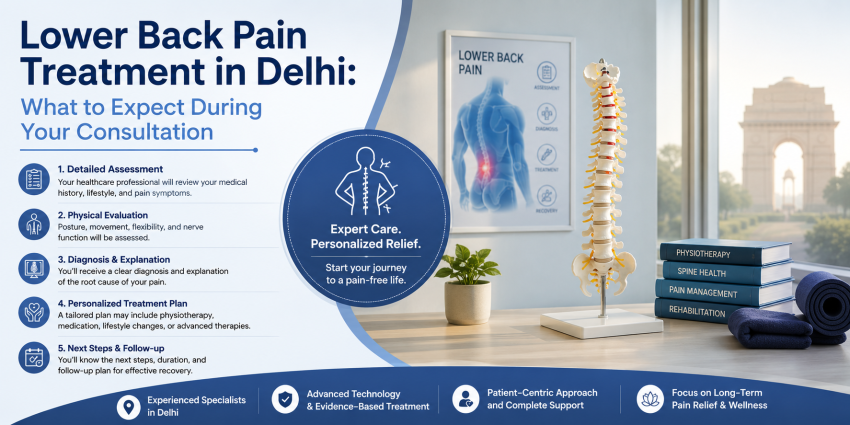
In most cases, lower back pain is a brief discomfort that occurs as a result of physical exertion, but in others, it becomes a chronic issue and can impact the ability to perform at work, move, sleep and do daily activities. Some episodes may get better over time and with the right self care, but if the pain is on-going or recurring it will require medical assessment. It is important to know what to expect during the consultation so that patients are not daunted, and can discuss with their doctor and base their choices on accurate information.
The first visit to a doctor regarding lower back pain treatment in Delhi is among the most significant steps towards understanding the possible cause of pain and the type of treatment that can be used, if any.
The first step in the consultation is that of your medical history
A thorough discussion is a crucial component of the evaluation of low back pain. Your doctor may ask about the onset of pain, whether sudden or gradual; how often it happens; and what makes it better or worse.
You may also be asked if the pain is in the lower back or it moves towards the hip, buttock or leg. Numbness, tingling, weakness, stiffness or changes in mobility may be additional symptoms that can give further clues.
Any previous medical history, injuries, medication history, treatment history or health conditions may also be discussed. The information can help the doctor to consider your specific situation, instead of just focusing on the pain.
A Physical Examination is beneficial to the identification of a problem
Discuss your symptoms with the doctor, and then examine you physically. This may include an evaluation of your movement, posture, flexibility, muscle strength, sensation and some neurological responses.
It is not just to find out the location of the pain. There are several possible causes of lower back pain, whether it be from muscles, joints, discs or nerves. Your doctor can then use a clinical examination to get a better idea of what could be causing your symptoms.
One important reason why a consultation cannot be based on a report from an MRI or X-ray. The results of an image should be interpreted in conjunction with clinical examination and symptoms.
Do You Require An MRI or X-ray?
Not all people with back pain require a scan right away. In simple cases, a medical history and physical examination might be sufficient to start the right treatment. Imaging may be used if symptoms don’t improve, certain conditions are suspected, there is concern for nerve involvement, or there are certain warning signs.
Bring along the results of an MRI, X-ray or CT scan to your appointment if you have had one of these tests. Treatment history and/or past prescriptions may also be helpful.
Talking about the Treatment Options
After evaluating your symptoms and the results of the reports, your doctor will talk to you about treatment options. Treatment will vary based on the cause of the pain, the length of time the pain has been present, the level of pain, how well the pain is limiting activities, and other medical problems.
Conservative treatment includes physical activity, therapeutic exercises, physiotherapy, posture and workplace changes and medications (if applicable). In individual situations, specialist pain management procedures or other interventions can be considered.
More importantly, consultation does not automatically mean surgery! There are a variety of non-surgical options available for treatment of lower back pain, and procedures or surgical referral may be considered if clinically appropriate.
The following are questions that you can ask during your appointment:
Consultation is also a time for you to learn about your condition. Consider asking:
- What might be causing lower back pain?
- Will I require any tests?
- The treatment options that are available
- If there are any any non-surgical options
- What steps could I take to prevent recurrence?
- When will I need to have a check up?
These are questions that can be helpful in a consultation so that you know what to expect and can make the most of the time.
Conclusion
Preparing medical records, having an accurate and detailed explanation of symptoms, and a comprehensive discussion with a knowledgeable healthcare provider can enrich the consultation for lower back pain treatment in Delhi. It is important for you to determine the reason of the problem and choose the most suitable solution.
Written & Verified By:

Dr. Vivek Loomba
Specializes in Pain Management and Palliative Care

