
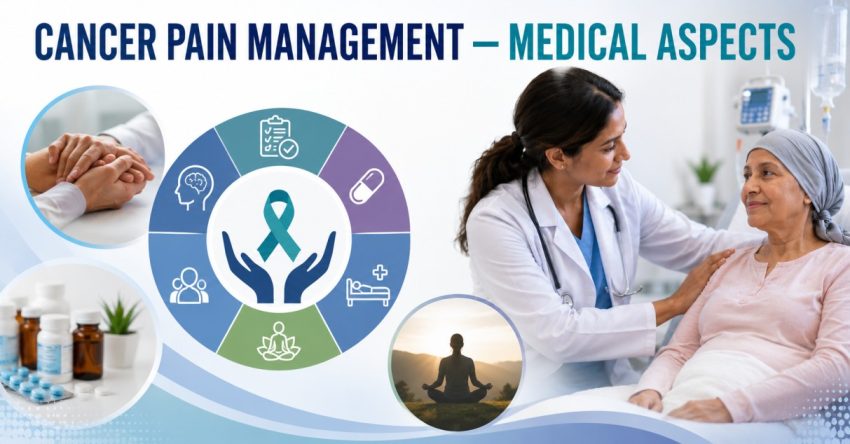
Cancer pain continues to remain an enigma both for the physicians, patients and their families even after over 20 years of a campaign to make pain the fifth vital sign.
The primary barriers for effective pain management include (1) Inadequate pain assessment and management training (2) Failure to refer patients to Pain Management physicians, (3) Patient reluctance and poor adherence and (4) Acceptance of pain as a part of natural disease process (5) Financial constraints.
Healthcare providers need a holistic approach for effective pain management in these patients. Pain management steps include:
1. Assessment of Pain
2. Management of Pain
3. Prevention and Management of Adverse Effects
ASSESSMENT OF PAIN
Cancer pain can result from various etiological factors. It could be nociceptive ( pressure on nerves), visceral (distension of hollow abdominal organs), neuropathic (direct damage to nerves) and incident or movement pain (secondary to fractures, bone damage from cancer etc).
Pain is assessed by using various pain scores — VAS (Visual analogue score), NRS (Numerical rating scale), NVPS (nonverbal pain scale) etc. Pain is broadly classified as mild, moderate or severe.
MANAGEMENT OF PAIN
The WHO analgesic ladder was proposed by World Health Organization (WHO) in 1986 to provide adequate pain relief in cancer patients. The three main principles of the WHO analgesic ladder are: “By the clock, by the mouth, by the ladder”. By the clock: To maintain freedom from pain, drugs should be given “by the clock” or “around the clock” rather than only “on demand” (i.e. PRN). By the mouth: The medications should preferably be given orally. By the ladder: The WHO recommends using nonopioids + adjuvants, followed by weak opioids + adjuvants, followed by strong opioids + adjuvants in that order for managing pain in these patients.
Several studies have confirmed that 71–76% of patients have “satisfactory” pain relief with the WHO 3 step analgesic ladder.
The medications used include
1. Acetaminophen (crocin)
2. Non Steroidal Anti inflammatory drugs (NSAIDS) like ibuprofen, diclofenac sodium, etoricoxib etc.
3. Weak opioids like tramadol
4. Stronger opioids like morphine, fentanyl
5. Adjuvant drugs like antidepressants (venlaflaxine, duloxetine) anticonvulsants (pregabalin, gabapentin, )corticosteroids
6. Bone strengtheners like bisphosponates, denosumab, calcitonin
7. Topical drugs like menthol, lidocaine 5% patch, ointments containing NSAIDS.
Non drug pain management treatment includes acupuncture, various nerve blocks, radiofrequency ablation, spinal cord stimulation, peripheral nerve stimulation and intrathecal pain pumps.
MANAGEMENT OF ADVERSE EFFECTS
The common opioid side effects include nausea, vomiting and constipation. Constipation is managed by an aggressive bowel regimen, and also drugs like methylnaltrexone. Nausea and vomiting is controlled by dopamine antagonists such as prochlorperazine or metoclopramide or serotonin-blocking drugs like ondansetron and granisetron. Other side effects are relatively rare, but patients need constant monitoring for early recognition and effective treatment of any adverse effects.
In nutshell, managing cancer pain can be an arduous task. An experienced Pain Physician is an asset of multidisciplinary cancer management teams. The use of multimodal analgesia in a step-by-step approach goes a long way in controlling pain in these patients, thereby making their lives more comfortable.
